A Book by its Cover

The travel my work often demands can at times grow monotonous, both out here on the road, and for those patiently waiting on the home front. One of the perks the road does afford, is not just opportunity to build, maintain, and effect repair on bridges and other historic timber framed structures both far and near, but such extended travel also provides an ability to visit wooden bridges in distant States and regions, and in their many regional variations. This I have done in a dozen States now, and in numbers approaching two hundred examples.

With all this exploration, it becomes more and more evident that Bridgewrighting historically seems to have attracted and or was only open to the best of the best amongst timberframing practitioners. The attention to detail and the average level of workmanship in bridgework (examining dismantled joinery and the workmanship found within the normally unseen faces of timber joints drives this point home particularly well) necessarily tends to run several gradient levels above that found in most (exceptions sometimes being mills and steeples) other types of joined timber structures. I have of course come across examples which exceed even these norms, and count these for this reason as among my favorites. Their Bridgewrights, I likewise hold in a higher regard and level of admiration than I do most.

As I take up my road warrior weekends with visits to an areas sights and bridges, occasionally the road finds for us that unexpected multiple exception. A bridge that exceeds norms and expectations, and every so often happenstance also happily finds such an example which has seen over its service life the simple maintenance which keep such bridges in near perfect almost original condition, and in a state of service health which will see it continuing to carry traffic well into the future -

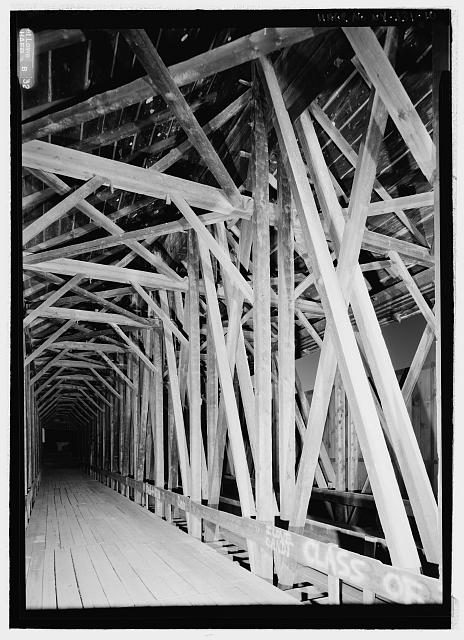
Photo courtesy of the Library of Congress and The NPS Historic American Buildings Survey / Historic American Engineering Record - Photo Credit Cervin Robinson Taken during HAER's August '58 documentation

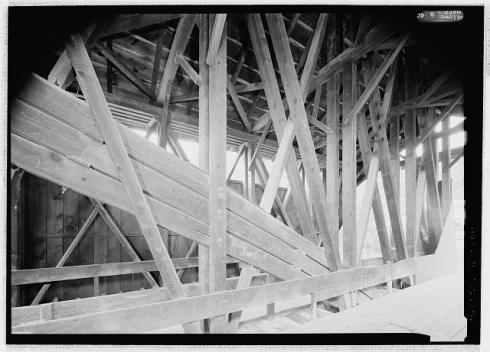
Photo courtesy of the Library of Congress and The NPS Historic American Buildings Survey / Historic American Engineering Record – Photo Credit Cervin Robinson Taken during HAER’s August ’58 documentation

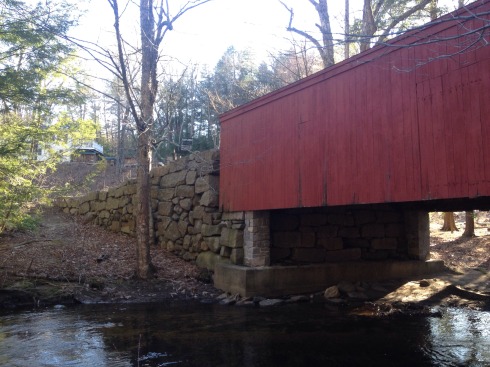
Berk’s County Pennsylvania’s Griesimer’s Mill Covered Bridge is such an example, this despite its current state of a few cracks in the siding and an unkempt appearance suggested by currently peeling paint. This the root of my don’t judge – A Book by its “Cover” reference and entry title. The Griesemer’s has clearly never seen any sustained period of poor care or a failure in simple maintenance, and the workmanship seen in what few repairs it has required over time have been well designed and executed with care and ability. The County even recently announced the bridge will receive a shiny new coat in the coming months, ( bit.ly/12RTsVV ) and seems well aware that simple maintenance over long service life is far cheaper than the major repairs which a failure to see to such care so often necessitates.

A name for The Griesimer’s Bridgewright seems to have fallen from the record, (even its build date is somehow shrouded in minor mystery and often repeated misinformation) and this is unfortunate as such knowledge and ability should be honored and exemplified even all these years later. The details chosen and the the level of care taken in their execution are quite obviously part of how and why this bridge continues to carry traffic and “Positive” Camber into the present day.

In irony it is the amazing condition this Bridge is in which has me antithetically worrying after its future – It is near time for a minor going over. One of the downstream Shelter Panels has racked out of plumb giving the impression the bridge is listing, even though the Truss beyond it is strait and true. The upstream arches have some minor distortion which should be arrested and straitened before this task grows in complexity. A scarf or two could use some slight tightening and tuneup.

My fear is that at the next incursion this extraordinary example of a Burr which has been carrying traffic admirably as constructed for a century and a half, will see the rubber stamp rehab common to this area, and like the nearby Pleasantville, also in Oley, it might well be transformed into a Steel Stringer Bridge and the wooden through truss will in reality cease to carry the rolling loads it was built for, and is still well suited to carry into many tomorrows.

This Bridge was built for better, this Bridge was built for more.

The Griesemer's, an exqisitly joined Burr has all the best details used in its framing including Double Arch Rings

The Griesemer’s, an exquisitely joined Burr has all the best details used in its framing including Double Arch Rings

Joggles to to provide an abutment for the load imparted by the Braces – Check Braces to buttress the moment imparted are an all too infrequently used feature to Burr’s – Note also to the left of the Check Brace a Joined Scarf / splice – An unusual detail for a Top Chord

Arch sections are joined in Bolted Half Laps and are identified with the somewhat unusual feature of Carpenter's Marks - A Feature common to other Berk's County spans - Note also the Red Grease Pencil markings

Arch sections are joined in Bolted Half Laps and are identified with the somewhat unusual feature of Carpenter’s Marks – A Feature common to other Berk’s County spans – Note also the Red Grease Pencil markings

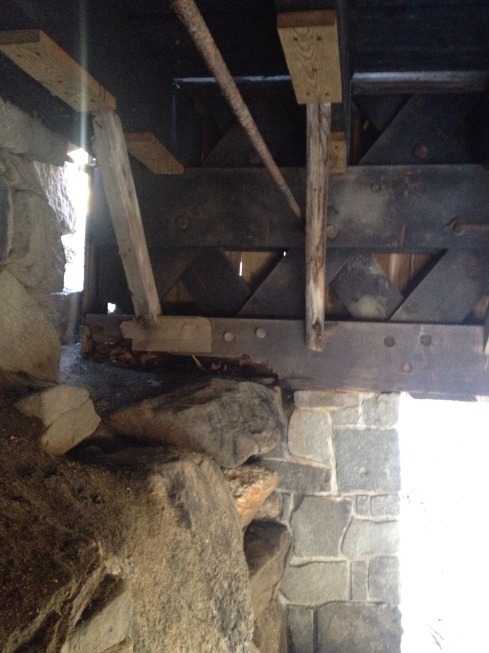
Bottom Chord Scarfs of the Stopped Splayed variety with Bolts both shared by and with the Scarfs backed up by the Lower Lateral Bracing system - Our nameless Carpenter a Bridgewright on the ball

Bottom Chord Scarfs of the Stopped Splayed variety with Bolts both shared by and with the Scarfs backed up by the Lower Lateral Bracing system – Our nameless Carpenter a Bridgewright on the ball

Commissions, consultancies and structural condition assessments always happily considered – Feel free to drop a line.


A Riddle’s Answer – Exemplifies the Why

As followup to last months Riddle entry – A deeper look at this third and last of those 1790′s New Hampshire wooden spans often also described as a groundbreaking first on the national stage, this squint does find our Riddle, in some measure solved. We do know who contracted the six span five hundred and fifty six foot bridge to be built. This in itself is a hugely interesting story, at least from a local history perspective.

Seemingly missing from our ever unwinding scroll of recorded history are those answers to what from my perspective, are the far more interesting questions. Those being who designed it, who framed it, how the truss-work was configured, and what did this piece of yesterday look like?

These multiple missing pieces, despite long ago prompts that this was structurally somehow a significant ahead of its time multi-span bridge, sometimes described as a first in true truss bridges – An enticing bit of plausible real information sadly intertwined with an oft repeated bit of misinformation. These details of the structural specifics of this long span wooden bridge are pages of our common history that are sadly and seemingly, forever lost to us.

This first bridge at this crossing, The Amoskeag Bridge (not to be confused with Amoskeag Falls a later bridge just up-river, an iteration of which Wm. Riddle’s company would build) like most every other in that period, was built by a for profit company formed expressly for this purpose. This both to collect tolls. And to attract traffic to the area as an unknown convenience and option superior to then available ferries to those traveling to, or more importantly and more profitably, those moving goods and materials or driving stock to points west of the Merrimack.

A Boston Paper described completion of The Amoskeag in an October 1792 edition -

The Principal in this effort, Robert McGregor, was a mover and a shaker of his time. And arguably had hand in shaping both the Nation and the State. And while he is not forgotten to history, it is almost confusing that his many efforts and accomplishments are as under-realized and little acknowledged as they now are.

His National front efforts begin with service in the Revolution in which he rose to rank of Colonel and served as Aide de Camp to General Stark. Robert would a decade later, while a member of the State Legislature attend a special meeting at Exeter and vote with the majority to ratify the United States Constitution.

Col. McGregor seems to have left the war effort about the same time as his commanding officer, and would purchase land just downriver and on the opposite bank from the mill the General ran in Derryfield just above Amoskeag Falls. Years later Stark was heard to say, when the charter was sought and potential stockholders were thinking of investing in his former subordinates Amoskeag Bridge Company “Zounds – Build a roadway over the Merrimack? Man alive, you nor I will ever live to see it done!” General John would then go on to cross The Amoskeag for some twenty years.

A first in a long series of varied businesses McGregor would engage in in the coming decades, would be that of his former commander. Beginning in the mid 1780′s Robert would long own and operate a series of area sawmills. (This clearly would have had him long knowing the area’s carpenter’s & millwrights – Both being groups of highly skilled people capable of sophisticated framing – Who did he choose to design and frame his bridge?) He became active in Goffstown politics, for many years serving as Selectman, and serving as Moderator for much of the 90′s – He simultaneously served many terms in the State House which was at this time still meeting in the former colonial capitol of Portsmouth. Roberts business pursuits were many and varied, he for a time even held a license to sell “Spirituous Liquors” Two years after the Bridge Company completed its endeavor Robert would become principal in the Isle of Hooksett Canal Company. Among numerous other cooperative ventures he would in time be counted among the founding Proprietors of The Amoskeag Cotton & Woolen Mill.

For many years after this subsection of Goffstown was annexed to the City of Manchester, the area of the city served by the west bank end of the Amoskeag Bridge was known as McGregorville. Several replacement bridges at the same location would go on to carry the name McGregor. In time the neighborhood and the Bridge would come to be known as Notre Dame.

The Notre Dame built in 1936 stood in the location of the 1792 Amoskeag until its 1989 demolition - Post Card image courtesy of The Boston Public Library

The Notre Dame built in 1936 stood in the location of the 1792 Amoskeag until its 1989 demolition Post Card image courtesy of The Boston Public Library

The 1792 Amoskeag Bridge venture though both an immediate success, and having had the lasting effect of to this day shaping the face of and traffic patterns to and through the City, seems to have in the years that followed, been one of Robert McGregor’s few profit failures. In 1796 the Proprietors petitioned the General Court for an increase in tolls, “’The prayer of their petition was granted” The failure to realize any profit on investment seemingly continued, Being open to the weather the giant would see an exceedingly short service life. By 1812 it was judged to be “impassable to teams” – Those on foot did continue to cross at their own peril for some years.

Though the bridges primary purpose, of a realized return on investment for the stockholders of the Amoskeag Bridge Company never came to pass, Robert’s obvious secondary purpose was amazingly & blazingly successful – It forever changed commerce, in that area he knew best, and held as home.

With its short service life limiting any potential return or profit on this speculative venture, perhaps the well known Amoskeag may well have served as example to those near and far that an investment in any wooden bridge should and would best be protected by simple sets of cladding & roofing -

Looking upstream under the current concrete deck bridge - The fifth span to cross at this location The fourth to stand as replacement for the city shaping Amoskeag

Looking upstream under the current concrete deck bridge – The fifth span to cross at this location – The fourth to stand as replacement for the city shaping Amoskeag

Just downstream an empty set of piers now serving little more than childhood wonder

Just downstream an empty set of piers now serving little more than childhood wonder

The Bridgewright Blog would like to thank the staff of The Manchester Historic Association Research Center for their cooperation and assistance in locating source materials during research in preparation for this Riddle’s Answer entry.


A Riddle Unsolved

I have, in prior entries, (See April ’12 archived entry Sticks and Stones and Service Life) alluded to how my coming up within seasonal sight of, and always within earshot of Watt’s Brook, and none so far from its confluence with the Merrimack River did much to form my understanding of how our world works. My relationship with this River goes back even farther, with one of my earliest memories going back to a time when I was still toddling, still pre-school, when my parents influences and those of my surrounding world provided my education. This just after our moving north from Rhode Island, when repeated new neighborhood unavoidable bridge crossings provided a growing awareness of my Mother’s almost quietly kept to herself, thinly veiled terror of bridges. A why is she acting differently realization which grew with each and and every time we needed cross “The Triple Bridges” at Hooksett Village. A realization which saw me looking at the river scenery flicking by the cars window with a sense of wonder just in some small way, different, than what was found in our woodlands and farm fields and city-scapes.

The Merrimack, long an aspect of my daily life, with an abundance of empty bridge piers would go on to provide much of the wonder which would in time grow into a fascination with both history, and the bridges mankind has provided for itself to help navigate our world.

Photo courtesy of C. Hanchey - The piers for both the Village Bridge and the neighboring RR triple span were formerly home to a series of covered wooden examples of various truss types - This Riveted Pratt was designed by John Williams Storrs (paste to search box for more info) was built in 1909 and bypassed in 1976

Photo courtesy of C. Hanchey – The piers for both the Hooksett Village Bridge and the neighboring RR triple span were formerly home to a series of covered wooden examples of various truss types including those of Briggs and Childs – This Riveted Pratt was designed by John Williams Storrs (Copy & paste to the blog search box for more info) It was built in 1909 and bypassed in 1976

In researching last months piece on Timothy Palmer, a Bridgewright who had spanned The Merrimack not once but twice, I again came across mention of another 18th century long multiple span example on my home River, this one once having stood in the twenty five mile stretch of the river I know best. It served at a point on that stretch of The Merrimack known now and then better than any other to the areas inhabitants. This being the Falls known as Amoskeag. This bridge then connected two villages, on the west bank a former part of Goffstown, on the east bank a second village then known as Derryfield – Both banks are now encompassed by the City of Manchester.

In both local histories, and in some of those many describing the history of bridge building, this 1792 example is often described like other contemporaneous examples built the same decade within the States borders, Hale’s at Walpole and Palmer’s Great Arch. This Merrimack example described as another first, as in this following excerpt from Wm. Hubert Burr’s Ancient and Modern Engineering – “The first long span timber bridge, where genuine bridge trussing or framing was used”

I have in coming across such description in the past, of a bridge on a part of the river well known to me, one still bridged at this location, and one within sight of some of those empty sets of piers which have given me so much wonder…

Worked to find deeper information on both this bridge and its builder.

As it turns out, though information on the often named builder showed itself when I recently scratched again for more. It more than appears that neither he nor his firm built the 1792 span. Though record suggests one of his numerous companies was engaged in bridge building, and did span the Merrimack at Manchester – In 1792 Wm. was but three years old, and his bridge building concern was years away from formation.

So somehow, long ago in the chain of record, Col. Riddle was named as builder of this bridge in error. And as all too often happens, an error is repeated and then somehow repeated time and again.

Here this chain breaks. And with the seemingly strange irony, that a realized understanding raises a greater question. This mystery, like The Merrimack in our coming Springtime – deepens.

Who was it that did build this bridge? And was it as described, a first in true timber truss bridges, is now the Riddle which needs solving.

So being now home again, jiggity jig – For me a trip to The City, its Historical Society, and The Falls is just over the coming horizon.


At the Beginnings

This ramble finds us returning to our very beginnings. Those of this weblog and our ongoing series on New Hampshire’s historic connections to wooden bridges, and a first entry mention of Mssr. Timothy Palmer’s Piscataqua “Great Arch” near Portsmouth New Hampshire. We will also look into another of Palmer’s still noteworthy and known and to history spans, The Schuylkill Permanant Bridge at Philadelphia. Itself a beginning, widely acknowledged to have been the first of North America’s bridges to be “Covered” – And the man’s own words will tell us why.

Though not his first large and long bridge building effort, The Great Arch at 244′ was Timothy’s longest ever span. Seen as a marvel of its time, it brought worldwide attention, and great renown to its builder. And was arguably directly attributable to this Newburyport Massachusetts resident native being offered bridge framing contracts as far afield as the Potomac at Georgetown.


Descriptions such as this, were quite commonly shared by then travelers to the new America, and were part of the renown brought to the builder of “The Great Arch”

Palmer was granted a patent in 1797 which in all probability would have held details of the framing of his Great Arch, had all record not been lost in the Patent office fire of 1836. ( see Dec ’11 archived entry Long Lost ) We do know it featured multiple lamination Chords composed of 16 X 18 X 50 Arch Ribs hewn following a natural curve in logs chosen and harvested specifically for this purpose, and that the Arch rose twenty seven feet at mid-span.

The Permanent Bridge, built a decade later. Was like The Great Arch, built by a for profit company formed for this purpose and funded by the sale of stock. In part to maximize fully any potential return on this investment for the duration of toll taking period allowed by the city’s charter, until that charter required it be turned over to serve as a free bridge. And additionally to allow it to continue to carry any and all traffic types for that duration, meaning Drover led stock taken on the hoof to market, and the heavier Teamster type loads of freight which demanded the larger tolls – The Schuylkill Permanent Bridge Company President Judge Richard Peters, saw fit to suggest the company board in and roof over their bridge.

Palmer, their chosen bridgewright, had long been a proponent of such enclosure to protect his work from the elements and extend its service life, and explained in great detail the simple reasons why in a letter to one of their agents:


Opened to traffic on New Year’s Day 1805, it would though ultimately be removed and replaced in 1850 with a truss without any arch following rises in its multiple spans, these being unsuitable to also carry the rail traffic its replacement was expanded to accommodate. Palmer’s Permanent Bridge exceeded his conservative suggestion that boarding in his through trusses might add as much as thirty or forty years to a wooden trusses service life.

And time has proven that such trusses, with a properly maintained enclosure have an exceedingly long service life. Surviving examples in both New Hampshire and Pennsylvania are yet carrying vehicular traffic, now well beyond their 175th year.

Palmer’s final bridge, built the following year, spanned the Delaware connecting Easton Pennsylvania and Philipsburg New Jersey. It featured an improvement, of a level floor through his Trussed Arches. It would continue to carry traffic until its removal in 1895. An end and a replacement, which like that of the Permanent Bridge was more about traffic type and volume, than a service life which had reached its end.


Commonly Un Common

The Square Rule is, as I suggested in the last entry, not just back on my current, but it is now my actual horizon. A part of my here is now everyday. As is this wondering as to why it was the people who chose to use it, this Square Rule, chose to do so.

It is a funny place to be in in more ways than one. As is the fact that I might gaze through a window few can share – I know what it is to wonder after the efficacy of which system to use for any given Timber Framed construction. To ask which system of Timber Layout, Scribe or Square Rule is the more, or even the most appropriate. This a window common to a few of my contemporaries. Though one last wide open for but a brief while, centuries ago now, when this rapid shift from the Scribe to the Square was yet underway.

And I think the perspective I view all this through, is far from common. To know traditional versions of both systems of layout is not common even among framers. To have a working sense of both historical framing of buildings, and those of bridges is maybe even more so. All this is a circumstance and a happenstance and a perspective, which was once commonly shared. The once sense of everyday of a common country carpenter, but now some of the little explored vagaries of a hyper niche carpenter. That said, I still see myself as a common country carpenter. Perhaps it is the every tree is a timber, commonality traditional timber framing has with the sawlogs we are often involved in “converting” – It is in this work, none so uncommon to choose timber in the woods and on the stump. Something we have done here as part of the Bernhard Barn restoration, the two Tulip stems which will serve as species in kind replacements of the one piece fifty foot hewn from the round Wall Plates still stand in their forest and yet touch the sky, and do not yet know that they will be part of the next chapter in the ongoing story that this Barn will continue to tell.

It often crosses my mind that this thing of being a Framer with an inter-discipline sense of things is an all too small club, one with a membership far far too short in numbers.

So, all that, and with the other high horizon focus, The Blenheim, seem to bring us back to where this blogging adventure began, with Long Trusses and The Square Rule and who might have taught who what, when it came to bridge framing, (see the May & June ’11 archives) now swings back and over into a parallel and perhaps as seemingly and an almost equally unanswerable exploration. Who was it who brought the roots of Square Rule to the table, and where was that place that they called home?

Semi parallel interwoven puzzles and a wonder after both, send us in search of clues to either, and we find yet another letter of shameless self promotion from the good Col Long -

All this information for but three pence, the price of a nail so small, most might think of it as a tack.


A Now Two Century Old – Overnight Turn on a Paradigm

My revolving focus is often driven by a particular bridge, or its Truss Type, or an interest in its developer or Patent holder. My current attentions have once again revolved around to focus on something of deep and long interest, something that is the core of who I am and what I do. And interestingly something of a mystery, one which is perhaps this very year, slipping into its third century of wide use.

Traditional / historical timber framing layout systems became a preoccupation of mine something over twenty ago now. In part with a growing understanding that the non-traditional layout used by the shops in which the first frames I helped cut were executed did not have a practical level of success, and in part because it was a connection to history and a historical continuum which drew me to this Trade. That and ample example that historical layout systems did possess a level of predictable success and practicality “then” suggested to me that they would still share these same practicalities in the now.

I sought out practitioners of these systems – The Scribe Rule & The Square Rule. (Scribe being the direct transfer of information from one timber or set of timbers to another – Square Rule being the shaping of timbers to a mathematical constant at each of its connections) And have gone on to, as a rule not an exception, regularly practice both, and also to teach traditional layouts in a series of workshops over the last dozen or so years.

Though in part it is out of preference, it is happily also out of practicality that I lean towards the Scribe side of things. With much of my work being Bridge related, and with Timber Bridges being the seeming lone exception (this due to slightly dissimilar pieces in what appear to be like and redundant, mirror image Panels – small inconsistencies driven by camber) to an amazingly rapid and geographically vast shift (here on the North American continent) away from variations of Scribe which had been the norm for timber carpentry for millennia.

Scribe layout survived all the many changes humanity brought to its fellowship and the need to house itself, including this migration to a new continent, this particularly well exemplified here (forty or so miles from the coast and just outside of first period settlement) in my little patch of Northern New England. Here settlement was, for the best part of the first two centuries of the then Colony’s existence, incredibly slow to expand. Long hostilities with the neighboring colony including cross border raiding, and raids encouraged from those neighboring colonials among Tribal peoples from both sides of the border. This pressure saw to it that settlement held fast at a standstill from the 1630′s through the 1760′s – As did building technology. As is found elsewhere in the New World, settlement patterns heavily influenced construction, in that colonials brought with them what they knew. This is particularly true of Timber Frame Carpentry, with country of origin and even regional variation in the home country heavily influencing the many regional variations found in the former Colony/ies. Framing style, technique and typology were brought from the Mother Country. Here in New Hampshire that transplanted Mother Country typology would be English Tying, in dominant use from the early 17th Century – the “First Period” on through to an end to the expansion standstill, and on into an area wide expansion and building boom. (settlement beyond coastal areas and nearby river valleys) The building boom and now rapid expansion of settlement brought on by an end to these formerly unending hostilities, this end coming with the close to what is little realized as, but was in truth the real first “world war” one encompassing multiple nations simultaneously on multiple continents – Known here as the French & Indian War, and elsewhere to history as the Seven Years’ War. Both Scribe and English Tying would survive this war and follow the boom of settlement into interior sections and remain in dominance another fifty years until a somewhat mysterious rapid change would morph both long used systems (Scribe & English Tying in both houses & barns) out of use in little more than a decades time.

An English Tying frame in Strafford County NH dating to the post F&I Boom-time

An English Tying frame in Strafford County NH dating to the post F&I Boom-time

This mystery of an almost overnight sensation shift away from what even here was a centuries old tradition in Scribe type layout has been high on my mind of late, with the current project being a Settlement Period barn in Bernhard’s Bay New York (here “settlement” was the mid 1790′s through 1815 or so) on the north shore of Oneida Lake. The Bernhard Barn is Square Ruled, and though the exact year it was first built is not yet determined. (research perhaps including Dendro is in the works) In part due to some unusual detailing, I believe it may be the earliest Square Ruled building I have ever put eyes and hands on.

A settlement period building, the Bernhard Barn is an early Square Ruled example of a common barn typology

A settlement period building, the Bernhard Barn is an early Square Ruled example of a common barn typology

Tax records suggest the property was held by John Bernhard - The Farm was developed by his son John - Improvements beginning in 1815

Tax records suggest the property was held by John Bernhard – The Farm was developed by his son John – Improvements beginning in 1815

With long study, exploration and preservation work on historic structures in my home region on the edge of First Period development and what might be the Nation’s first building boom, the sudden move to Square Rule and the concurrent move away from English Tying has long intrigued me. This seems to have begun sometime in the second decade of the 19th Century, and somehow saw total acceptance as the norm as not just common practice here in layout, this rapid shift to Square Rule would become dominant practice over the entirety of the then young nation. Everywhere north to south and as far west as settlement carried, and in this same contracted time-frame.

Some few have suggested, and having seen first hand great numbers of timber framed structures from the period, in not just my home region, but also in most all of those areas then settled – I adhere to the theory that the rapidity of this universal acceptance over a hugely wide geographic area is directly attributable to another violent international struggle, one this year marking its bicentennial – The War of 1812, the theory holds that high hundreds if not thousands of Carpenter’s from all over the country were brought into the war effort (Hundreds did participate in a strategic effort to build Naval ships at pace on Lake Erie to outnumber British craft in what came to be known as the “The Battle of the Carpenter’s”) to build watercraft, bridges, earthworks & barracks buildings. They shared ideas and also a need to produce needed constructions quickly. An ability to throw more carpenters into an effort which lays out individual pieces mathematically than could possibly fit / fold into a Scribe layup assemblage, made this sheer numbers strategic advantage of Square Rule the Layout of choice for the wars duration, and upon its end Carpenter’s in great numbers returned home with a new tool in their kit. And in little more than a decade’s time, carpentry would forever be changed.

It is not impossible that Square Rule is also now marking its bicentennial year, and that this paradigm shift was in part responsible for setting the tone that the rest of the century would take. That conceptually the idea of interchangeable parts and mass production became an accepted norm and expectation and became part of the human psyche. All through this paradoxical chain of events, this bit about the horrors of war somehow leading to wide and rapid dissemination of a useful idea, coupled with humanity’s unending and simple need to house itself – And that this would in time and in turn, lead to techniques of mass production being used to also build, The Cotton Gin, The Springfield Rifle, and one day, The Tin Lizzy.


Quite Laterally, Here We Go Again -

Frequent fliers likely recall my June entry Meritocracy, (click on the highlighted & underlined text to be linked to the entry) in which I puzzled over the frequency with which contracts to repair and rehabilitate wooden spans are often awarded to companies who, know the ins and outs of bidding public works projects, but who hold nothing in their scope of experience to suggest they have the required tooling, knowledge, or abilities, to in-house execute such work. And somehow, nor are they necessarily required to pre-qualify, or ride the resumé of pre-qualified specialist subcontractors when preparing proposals to bid such contracts. Recent turns of event have again shown how sadly and commonly this circumstance happens.

A recent string of extreme truck damage incidents, leaving horrific levels of Portal to Portal damage, have splintered Tie Beams or dislodged and distorted Tie Rods and ruptured Braces in Upper Lateral Bracing Systems, in two bridges, one in Pennsylvania, one in Indiana.

Though it is often overlooked, complexity in a bridges framing is not limited to the Trusses proper. In some Truss types such as Towns, the more demanding framing is that found in the connecting systems which unify the two trusses and complete the “Through Truss”.

Tie & Lateral Bracing systems are far from simple carpentry, but are a complex bit of advanced Timberframing. (for all the camber driven subtleties and varied reasons I articulated in Meritocracy – Foremost among these being that proper fit requires the acknowledgement that these shoulders and abutments are, more often than not, not “simple” angles, but are in point of fact, compound angles. These necessarily need be laid out and cut to match real world camber driven circumstance – To drive home this point > In Bridge work, every joint which fails to have hard up full bearing through not just the visible portions, but the entirety of the joint, means undue crush and loss of geometry – This including, loss of camber) This circumstance of navigational error truck damage taking out such systems near or in their entirety, and the developing response to it, does drive home particularly well, this paradox of contracting concrete and steel outfits to repair or rehabilitate wooden bridges. At least it does from my perspective – Maybe from yours.

From mine, the perspective is particularly sharp. I cut my Bridgewrighting teeth on Laterals. I came into my first bridge rehab with seasoned timber joinery chops, and was pointed at Laterals – I took it as the performance challenge it was…

Since then, Laterals have kinda been my thing, and I’ve been privileged to help replicate whole sets. Both, all too many Lowers lost to high water, and the flotsam it inevitably carries with it. And in an odd bit of happenstance, multiple sets of Uppers & Ties lost to wet heavy snowload driven roof collapse on three different bridges in three different States. These all lost decades before, (one the year before I was born) and either badly replicated, or done with an inappropriately heavy species, or both, or replaced with inappropriate, not true to original framing systems. I have also of course, helped replace Wind Braces, as well as Ties & Laterals lost to truck damage.

These Bracing systems tend to vary in detail, this sometimes driven by Truss Type, and sometimes by regional norms, the date of construction, or the preferences of the Bridgewright who built the span.

Repair / replacement of the truck damaged Pennsylvania spans upper timber-work was recently awarded to a highway construction outfit. It had / has the Wind Braced Ties and Over / Under Laterals typical to Town Trusses, the dominate Truss type in that corner of PA. It remains to be seen if they will subcontract in a concern with a familiarity in these materials and construction methods to replicate the destroyed framing.

Said to be the work of Nichols Powers, in this “Village Bridge” NH’s Ashuelot, (Ash-wool-it) the terminus for the Lateral Bracing load was formerly shared by two Ties through this Centered Straining Beam- The Design Engineer specified placement of a final set of Double Laterals in either end bay as part of a late 90′s restoration.

I’ve long admired this detail used on Indiana’s Williams – Often incorrectly attributed to JJ Daniels, The Williams is a product of the Massillon Bridge Co.

In process Scribe layout of a Lower Lateral to replacement Floor Beams at Maryland’s Gilpin’s Falls – For more information on this Floor and the now unusual Rebated Sleepers seen here – See the May ’11 Archives

The most recent truck damage repairs I’ve had a hand in mending – Portal to Portal damage to the 266′ Mt. Orne

Also Scribed in-situ – The normally unseen connection where the Mt. Orne’s Laterals join each other


What Was Lost…

The entry here on the the Bridgewright Weblog which has seen more readership than any other, (and is still clicked in on with regularity) is now some thirteen months old. A piece titled Lost to Evermore, written in part in reaction to the devastation wrought by Irene. Some of which, as I put pen to paper in those first few days after the storm, I had already seen firsthand. Some, in the hard-hit Schoharie Valley of New York was at that point, less than fully known, to myself nor most anyone from outside the immediate area. Lines of communication were then down, and travel in and out of the valley was so hindered that little information about the level of damage had yet reached the wider world. What was known was that The Blenheim had been washed from its abutments.

With less than little known about the level of damage done to the Bridge, and with this blog being Bridgewright-centric, (for the most part but not limited to, an exploration of the works and work of Bridgewrights – Builders of wooden bridges, both past & present) my piece was as much about the builder of the Blenheim, as it was about the bridge itself.

The Bridgewright Nichols Powers – Photo courtesy of Schoharie Historical Society

Information then available suggested the bridge was not only lost, but had been all but erased – Even weeks later, in a group of folks at a Regional Gathering of Timber Frame Carpenters many of whom knew and had spent time on, in and under The Blenheim, (It being to the North American Timberframing Community among the greatest of works to be seen, somewhat akin to Chartres, the Parthenon or Pont du Gard) no one knew either what was lost or what might yet be found.

Many of us from outside the area assumed that the needs to replace and repair homes and businesses, to restore livelihoods and a sense of normalcy were the demands of the day for those directly affected by the floods. It was seen as perhaps not even reasonable to wonder after the post flood state of the Bridge.

Yet despite all this much to do, locals somehow made time for their Bridge. A recovery effort was organized, advantage was made of the seeming irony of a mild, almost snow free winter, and regular efforts in search and retrieval were made.

This gained a sense of urgency when the Blenheim’s National Historic Landmark Status was seen as in jeopardy, and it was suggested that any effort at rebuilding would have to include 51% of the original “fabric” to retain Landmark status. A lower than typical Spring Melt also cooperated with efforts towards recovery, and activity intensified as the weather warmed.

And more recently even as recovery efforts saw the transfer of sections both large and small to a common staging area, another setback. A FEMA determination that the The Blenheim, because it no longer carried vehicular traffic, is ineligible for funding. An appeal of this decision was recently heard, the finding and a final decision is yet to be determined.

Some of you may remember the shot of the Bottom Chord Scarf (Splice) I included in the Evermore piece. I no longer see the Bridge as lost, (If I ever did, the piece was about circumstance and reaction) or the situation as evermore. I do still see that magnificent Scarf, that startlingly beautiful and complex bit of cooperative workmanship, as being a yet unbroken connection still tying the Bridges past, to its future. I see this as area residents do – The need is to rebuild.

Preparations for rebuilding began, but will not end, with recovery and retrieval.

The following shots were taken on a recent non-related timberframe restoration trip into the area – Several of Powers chosen multiple abutment “Très de Jupiter” (Bolt ‘O Lightning) Scarfs are seen here also…

The Bridled Tenons which control the Wedge where the Counter joins an Arch

Double Mortises in an Arch section to receive a Counter and its Wedge

An Oaken Angle Block & a Cleat to receive a Set of Lower Lateral Braces and the Tie Rod which controlled them

The Blenheim materializing out of the mist on an early morning visit in the Autumn of ’07


Adulation for Bruno

In learning we had this past Fourth of July somehow missed acknowledging his 200th, and in looking for more information on the the good Mr. Pratt, we find adulation for Bruno…

I have several times here linked to full text clips of period bio-obits for historical members of the wooden bridge community. I quite like these as primary source materials, clearly they are written by close friends or associates, within weeks or months of someones passing. As such there are often found interesting nuggets of information, sometimes recorded nowhere else.

Here we learn Thomas Willis Pratt shared more than much in common, in a parallel lives sort of way, this far beyond bridges and bridge design, with others we have discussed here on these pages. Involvement in Railroading, and being often described as and thought of as an engineer, despite a lack of any degree.

We also learn he was involved in the building of Railroads and railroad bridges here in NH, and like his storied wooden bridge predecessor Timothy Palmer he also spanned the Merrimack in Newburyport. The thought that homage to his father Caleb was part of appending his name to the ‘ 44 patent was here affirmed. And somehow, we come to know he was a pamphleteer of sorts, often writing Boston papers using the “Nom de Plume” of Bruno.

Surprisingly, despite the success, even in his own lifetime of the “Pratt Truss” built then, and for decades on into the future, in a variety of materials and in many variations – The Bio suggests “ Mr. Pratt derived little or no pecuniary profit from the invention.” This leaving us to wonder why.

The author displays multiple biases, of the newer is necessarily better variety – Besmirching the name of the good Col. Long, based primarily on some assumption of an adherence of all wooden parts in an all wooden bridge, and seemingly an assumed and accepted superiority of iron over wood as a building material. He then carries on about “The advance of knowledge taught us to modify those notions of the powers of the camber, and of the need of Counters except for short distances each side of the centre of the bridge” – This sadly is to my mind, a first person contemporaneous suggestion, that then as now, design engineers were failing to seek any input from the very people they would conspire with to build their designs – Though calcs and models do suggest that but for those near mid-span, there is no need for Counters to convey loads from Panel to Panel – However, in the process of construction of wooden bridge trusses, with a number of truss types, they are useful in every panel in both the fully controlled development of, and in-service maintenance of camber.

He also (The author) then betrays his own suggested wood is inferior biases, in his description of Pratt’s April ’73 patent No. 137,482 – Though the bio, like the passing of Mr Pratt only follows the patent date by two years, we learn this all wooden truss had already been built in numbers. While most wooden trusses can be produced far far quicker than most people would today expect, I see that part of his description “Ordinarily it could be laid together and prepared for Tree-Nailing in an hour” as a bit of an exaggeration.

This Bio was written almost on the Eve of the Ashtabula Bridge Disaster, which would send shock-waves of change through the Engineering and Bridge Building communities, and I can’t help but wonder if the author perhaps tempered some of his thoughts in response.

– The following is from the Proceedings of the American Society of Civil Engineers Vol. 1 November 1873 to December 1875 -


Less than Hardwired for Hardware

If I were to define what it is I do, the description I see as mayhaps that one most accurately describing it, with both eloquence and in as few words as is possible, is simply to suggest that “I join timber”

My work is to take one of our planets greatest blessings, Trees. And to take their only modestly converted stems, (With variation, but in essence with only four sapwood slabs removed) and then join this blessing into useful configurations. Be it, houses, barns, or bridges.

In most such efforts joining timber, I find myself working to wholly avoid the use of large metal fasteners – This is almost one of the sub-definitions of what it is to be a Timberframer. Wood to wood is what we do.

Bridgewrighting, as allied a trade as it is, is a bit different. Even those Truss types without iron in them – Longs, Paddlefords, Burrs and Towns, still are often peppered with a smattering of bolts…

Many Truss types, share iron as almost an equal partner, equal in effort if not proportion of material used. A Symbiont of sorts, necessary to allow a largely wooden truss, to do what is asked of it.

Pratt’s are one of these “types” – So, echoed in the lyrics of one of my favored songs, with The First Day in August, last years local Timber Framers Guild project – The Wason Pond Bridge marked the passing of its first year, (see July / August ’11 archives) and I recently found myself willingly engaged in a once common bridgewrighting chore – A first of several, wrench in hand scheduled visits, to tighten Truss Rods and assorted Bolts to compensate for expected and predictable shrinkage as the Timber in the Through Truss seasons.

Joints again fully seated, camber re-tuned. All went as hoped for and expected, with but one small exception. The washers on some of the smaller Bolts sunk into the now dry White Pine wood grain as an attempt was made to re-tighten. I chose to replace these. My first thought was to go to the cast Ogee’s found so commonly in this application. Their cost and limited availability saw me turn to the second most common washer type found on Wooden Bridge Bolts – Large Square Flats.

As such explorations often do, I went looking for contemporaneous Rules of Thumb in what was seen as a norm for such hardware. In AJ DuBois’ – The Strains in Framed Structures – We find these not only crunched number, but period proven suggestions in his list of specifications.

As always, I like to point out how White Pine was and is, the favored Species for the framing of Wooden Bridges – Also from the DuBois List – Section VIII

In Jacoby’s – Structural Details or Elements of Design in Timber Framing – A wealth of information is found on the seemingly mundane subject of washers, as they are related to Timber Work.

The restoration of Maryland’s Gilpins Falls, is the only time we’ve worked with “Special Countersunk Washers” and their funky headed friction dependent Bolts. This bolt & cast washer type was also that chosen and used by Nichols Powers in The Blenheim.

The Wason Pond Bridge is fitted with a number of “Malleable Iron Washers” on both the smaller section Truss Rods at Mid-Span, and at the Tie Beam Bolts.

And like many other wooden spans, it is now home to a large handful of Squares.


Follow

Get every new post delivered to your Inbox.

Join 391 other followers